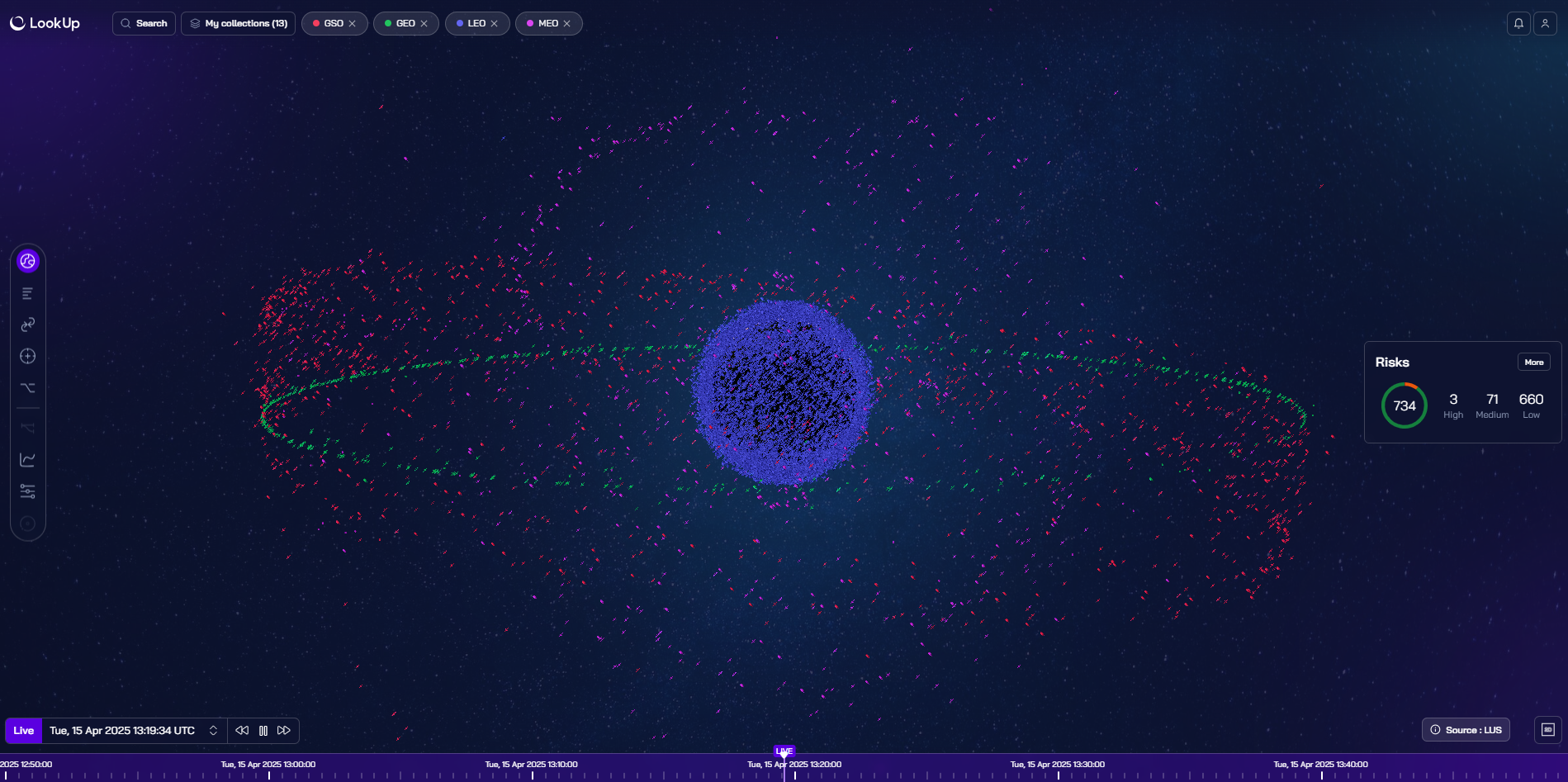




Building a sovereign Space Domain Awareness capability: A strategic necessity for Defence organizations
11
September
2026
Space has become a cornerstone of national security, underpinning critical defence functions such as communications, intelligence, navigation, and early warning. With the rapid expansion of satellite constellations, the proliferation of orbital debris, and the rise of counterspace threats, defence organizations need continuous, high quality and trusted awareness to act decisively in an increasingly congested and contested environment. In this context, Space Domain Awareness (SDA) is the foundation of strategic autonomy.
Achieving strategic autonomy requires continuous access to sensing capabilities, high accurate data, and timely analysis needed to take strategic decisions. Capabilities can be developed in-house, complemented through partnerships, or enhanced by commercial solutions, while ensuring the protection of sensitive information and preserving freedom of action.
Supporting strategic autonomy, from observation to understanding
The exponential growth of satellites and debris in Low Earth Orbit (LEO) is transforming the operational environment. As Collision risks increases and orbital behaviours become less cooperative, the distinction between harmful and non-harmful activities is becoming increasingly blurred. These developments introduce uncertainty in an environment that has become pivotal for military operations.
Historically, SDA sensing capabilities tracked objects and maintained basic catalogues. Today, defence actors must transition from sensing to understanding orbital behaviours, assess intent, and anticipate threats before a conflict escalates.
This shift requires transitioning from a static view to a dynamic operational SDA that shall answer:
- What is happening in orbit?
- Why does it matter?
- What may happen next?
This evolution, from knowing where objects are to understanding what they are doing and why, is the difference between basic surveillance and operational advantage.
Sovereign SDA as a collaborative industrial and technological challenge
In response to the evolving space domain, an effective sovereign SDA capability must remain adaptable, underpinned by a modular and collaborative industrial and technological foundation. Regardless of each government’s existing capabilities and available resources, it is possible to develop sovereign national capabilities spanning ground-based sensors to secure digital platforms.. Three scenarios illustrate how SORASYS and SYNAPSE support this approach:
- A government develops sensing and processing in-house: SORASYS and SYNAPSE reinforce its existing national capabilities with a proliferated high accurate radar network and the decision advantage needed to turn information into action.
- A government focuses on sensing, using its own sensor technology without an integrated processing layer: SYNAPSE complements that capability bringing the decision advantage needed to turn information into action. The government can still take advantage of the proliferated high accurate SORASYS network to complement its own capabilities.
- A government focuses on processing, with its own algorithms but without dedicated sensors: SORASYS high-quality proliferated radar network complements that capability with trusted sensing and data. The government can still complement its own processing capabilities with specific SYNAPSE modules that may be missing on its in-house solution.
Learn more about SORASYS and SYNAPSE
Strengthening strategic autonomy and industrial resilience
A sovereign SDA capability is both a security instrument and a long-term industrial investment. By strengthening domestically controlled systems and trusted partnerships, defence organizations can reduce exposure to critical dependencies, protect sensitive data, and foster local innovation aligned with national strategic priorities.
This approach ensures that critical technologies remain within national or allied ecosystems, reinforcing resilience and deterrence in space.
Sensor autonomy: the first pillar of sovereign SDA
Without reliable observation means, no trusted national SDA capability is possible. Ground-based radars like SORASYS provide persistent, accurate, and weather-independent detection, essential for building a trusted national space catalogue and supporting efficient decision-making.
Radars actively illuminate space objects, precisely measuring their distance and velocity regardless of lighting or weather conditions. This makes them particularly suited for defence use, where reliability and persistence are non-negotiable.
SORASYS is designed to integrate seamlessly into national SDA architectures, providing the trusted data foundational upon which sovereign space surveillance capabilities can be built and scaled.
Click here to read our article about why ground-based radar is a key technology for Space Domain Awareness.
Data mastery: The decision advantage of sovereign SDA
Modern military space operations generate massive volumes of heterogeneous data, from radars, optical sensors, partner networks and intelligence sources. Transforming this data into actionable intelligence requires a secure, real time and agile digital platform like SYNAPSE, whether a government is building its own sensing layer, complementing sensors it already operates, or adding additional intelligence capabilities to an existing architecture.
SYNAPSE fuses data from multiple sources, from sensor observations to intelligence inputs, into a unified operational picture. It supports threat assessment and behavioural pattern analysis, transforming disparate information into trusted, operational insights for faster national decision-making.
Click here to explore several use cases conducted by our teams with SYNAPSE
A partnership for sovereign SDA
Together, SORASYS and SYNAPSE illustrate a flexible approach supporting sovereign SDA, adapting to each nation's resources and existing capabilities. Look Up can support the next step forward.
- SORASYS provides the independent proliferated sensing infrastructure, a cornerstone for high quality and persistent national space surveillance.
- SYNAPSE delivers the secure digital backbone to transform raw data into operational insight.
This modular architecture addresses the practical reality faced by defence actors: building national capability at a sustainable pace while retaining access to trusted data, analysis, and technology. SORASYS and SYNAPSE can reinforce existing national systems or fill capability gaps, keeping critical know-how close to home, without requiring total control of every part of the value chain.
From space surveillance to strategic autonomy
As space is recognized as a full operational domain alongside land, sea, air, and cyber, the role of SDA will continue to expand. The objective is to monitor orbital activity, anticipate threats, protect critical assets, support command decisions, and preserve freedom of action, at a level of capability matched to each nation's strategic priorities.
Building a sovereign SDA capability is therefore a strategic, long-term choice, advancing step by step through local leadership, industrial collaboration, and trusted partnerships.
With solutions like SORASYS and SYNAPSE, nations can build the sovereign capabilities that matter most to them, at their own pace. Whether they operate complete SDA architectures or are prioritizing the in-house development of parts of it, Look Up supports their path with trusted data, sensors, and analysis.
As space-based systems become critical national infrastructure and space itself emerges as a potential theatre of confrontation, strong national SDA capabilities are essential to safeguard security, reinforce strategic autonomy, strengthen deterrence, and build resilience.
What to read next
.png)
11
September
2026
Building a sovereign Space Domain Awareness capability: A strategic necessity for Defence organizations
Why Space Domain Awareness (SDA) has become a critical priority for defence organizations, and how SORASYS ground-based radars and the SYNAPSE digital SDA platform can strengthen national sovereign capabilities in sensing, data processing, and analysis...