



Detect and Track
High-precision LEO detection and tracking powered by SORASYS


What SORASYS detects
Innovation
Curious and creative minds, capable of imagining bold solutions to complex problems.
Innovation
Curious and creative minds, capable of imagining bold solutions to complex problems.
Innovation
Curious and creative minds, capable of imagining bold solutions to complex problems.
Innovation
Curious and creative minds, capable of imagining bold solutions to complex problems.
Active satellites, defunct spacecraft, rocket bodies, fragmentation debris down to a few centimetres, manoeuvring objects, and previously uncatalogued objects, across the full Low Earth Orbit environment up to 2,000 km altitude, where more than 90% of space traffic is located.
Why choose radar technology
Innovation
Curious and creative minds, capable of imagining bold solutions to complex problems.
Innovation
Curious and creative minds, capable of imagining bold solutions to complex problems.
Innovation
Curious and creative minds, capable of imagining bold solutions to complex problems.
Innovation
Curious and creative minds, capable of imagining bold solutions to complex problems.
SORASYS operates independently of illumination conditions, weather, and light pollution, delivering continuous, high-cadence observations where optical systems have gaps. It measures range, range-rate, and Doppler shift simultaneously, producing the precise orbital elements needed for accurate conjunction assessment and manoeuvre planning. The system supports simultaneous multi-object tracking and rapid scan rates suited to LEO angular velocities, with real-time data integration into SYNAPSE for fusion, cataloguing, and alerting, and is accessible via API or interface for integration into client systems, including on-premise deployment for secure or classified operations.

Network deployment
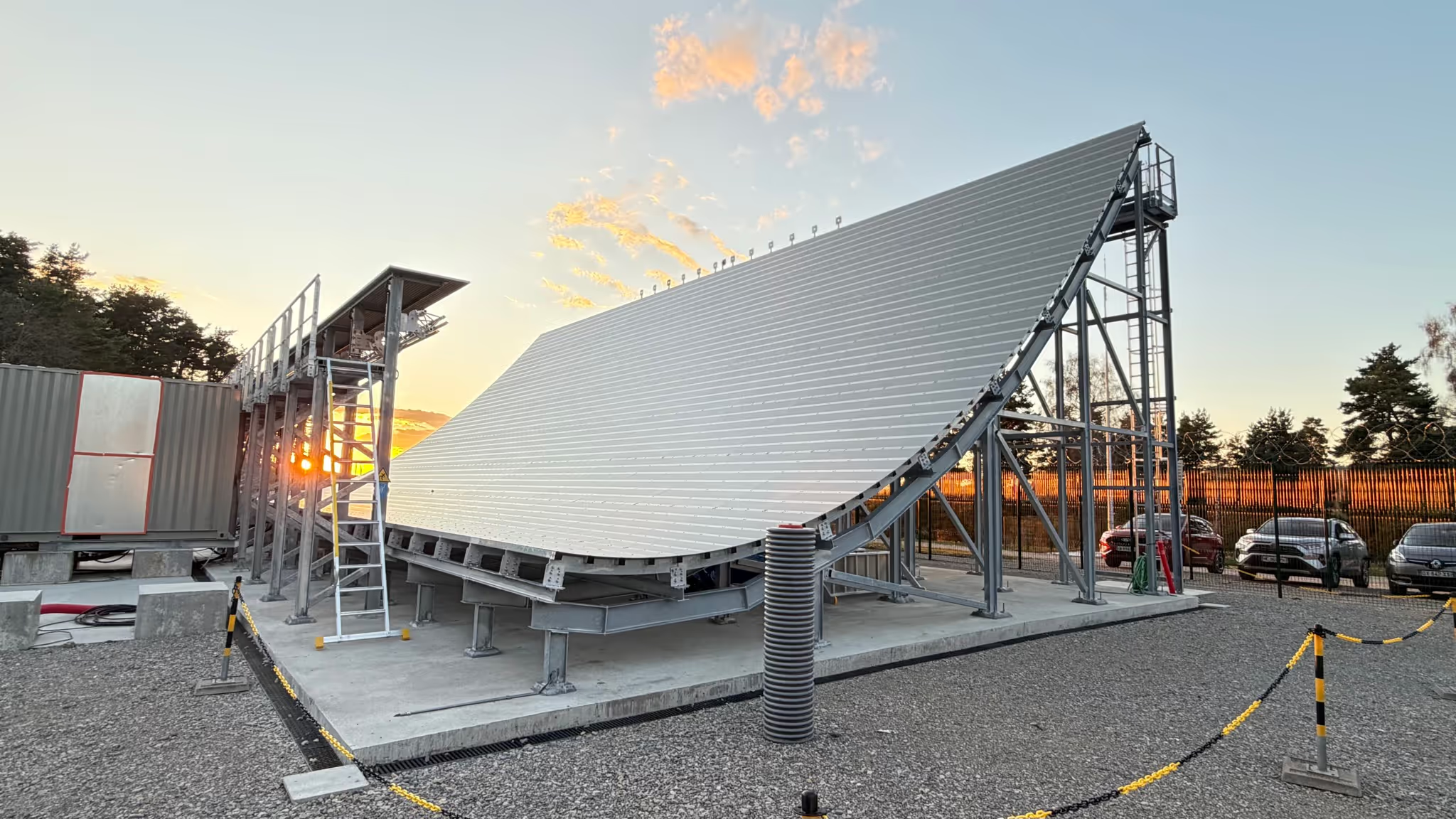
SORASYS-1
now operational in Lozère, France
SORASYS-2
SORASYS 2A "Rehua" and 2B "Matarii” are under deployment in French Polynesia
GOAL
7 globally distributed radars by 2030 for near-persistent LEO detection capability
Learn more about our solutions

.avif)