



Why ground-based radar is a key technology for Space Surveillance
19
January
2026
Radar vs. optical telescopes for Space Situational Awareness (SSA / SDA)
Look Up and the mission of Space Situational Awareness and Space Domain Awareness
At Look Up, our mission is to contribute to a safer, more sustainable, and more resilient use of space. As Earth’s orbital environment becomes increasingly congested, contested, and operationally critical, Space Situational Awareness (SSA) and Space Domain Awareness (SDA) have become a cornerstone capability for civil, commercial, and defense actors alike.
SSA consists in detecting, tracking, cataloguing, and characterizing artificial objects in orbit, including operational satellites, defunct spacecraft, rocket bodies, and space debris. Reliable SSA is essential to:
- Prevent in-orbit collisions and cascading debris events,
- Protect critical space-based services (navigation, Earth observation, communications),
- Support safe spacecraft operations and maneuver planning,
- Enable space traffic management and responsible behavior in orbit.
Several sensor technologies are used to observe the space environment from the ground. Among them, ground-based radar systems and optical telescopes are the two most widely deployed and complementary approaches. Read this article to learn why ground-based radar is often preferred for continuous and operational SSA in Low Earth Orbit (LEO).
How do we observe satellites and space debris?
There’s two main ground-based technologies
Optical telescopes (visible / near-infrared)
Optical systems passively observe sunlight reflected by space objects. They measure:
- Angular position on the sky,
- Apparent magnitude and its temporal variations (photometric analysis), providing information on rotation, attitude, or surface materials.
Ground-based radar systems
Radar systems actively illuminate objects with radio waves and analyze the returned signal. They directly measure:
- Distance (range), via signal time-of-flight,
- Radial velocity, via the Doppler effect,
- Radar Cross Section (RCS), related to size, shape, and material properties.
Both technologies are used today in national and multinational SSA networks (e.g. EU SST, US Space Surveillance Network), often in combination.
What are the operational strengths of ground-based radar?
Continuous operation: 24/7, day and night, all weather
Radar systems operate independently of sunlight and atmospheric transparency. They can function:
- Day and night,
- Through clouds, fog, rain, or storms,
- In the presence of strong light pollution or Moon illumination.
By contrast, ground-based optical telescopes are highly dependent on environmental conditions. Their performance is limited by:
- Cloud cover and atmospheric turbulence,
- Daylight (most optical SSA observations are night-only),
- Moon phase and sky brightness,
- Observation geometry, since satellites must be illuminated by the Sun and visible from the observer.
As highlighted by ESA and EU SST studies, radar can significantly extend the effective operational availability of SSA networks by filling observational gaps caused by weather or illumination constraints.
Direct measurement of distance and velocity
Radar provides direct physical measurements:
- Range, from signal round-trip time,
- Radial velocity, from Doppler shift.
These quantities are fundamental for accurate orbit determination, particularly for fast-moving objects in LEO, objects performing maneuvers, and short-arc observations.
Optical telescopes primarily measure angular position on the sky and apparent brightness. While angular accuracy can be extremely high, range and velocity must be inferred indirectly over time, which can reduce orbit accuracy for short observation windows or rapidly changing trajectories.
Detection of dark, non-cooperative, or unilluminated objects
Radar detects objects based on their Radar Cross Section (RCS), not on reflected sunlight. This enables detection of very dark or low-albedo objects, non-cooperative objects (no beacon or reflector), objects in Earth’s shadow (eclipse), debris fragments with irregular reflective surfaces.
Optical systems, by contrast, become effectively blind when objects are poorly illuminated or in eclipse, a frequent situation in LEO.
Detection of very small objects in Low Earth Orbit
One of the most critical challenges in SSA is tracking small debris, which can still cause catastrophic damage due to high orbital velocities.
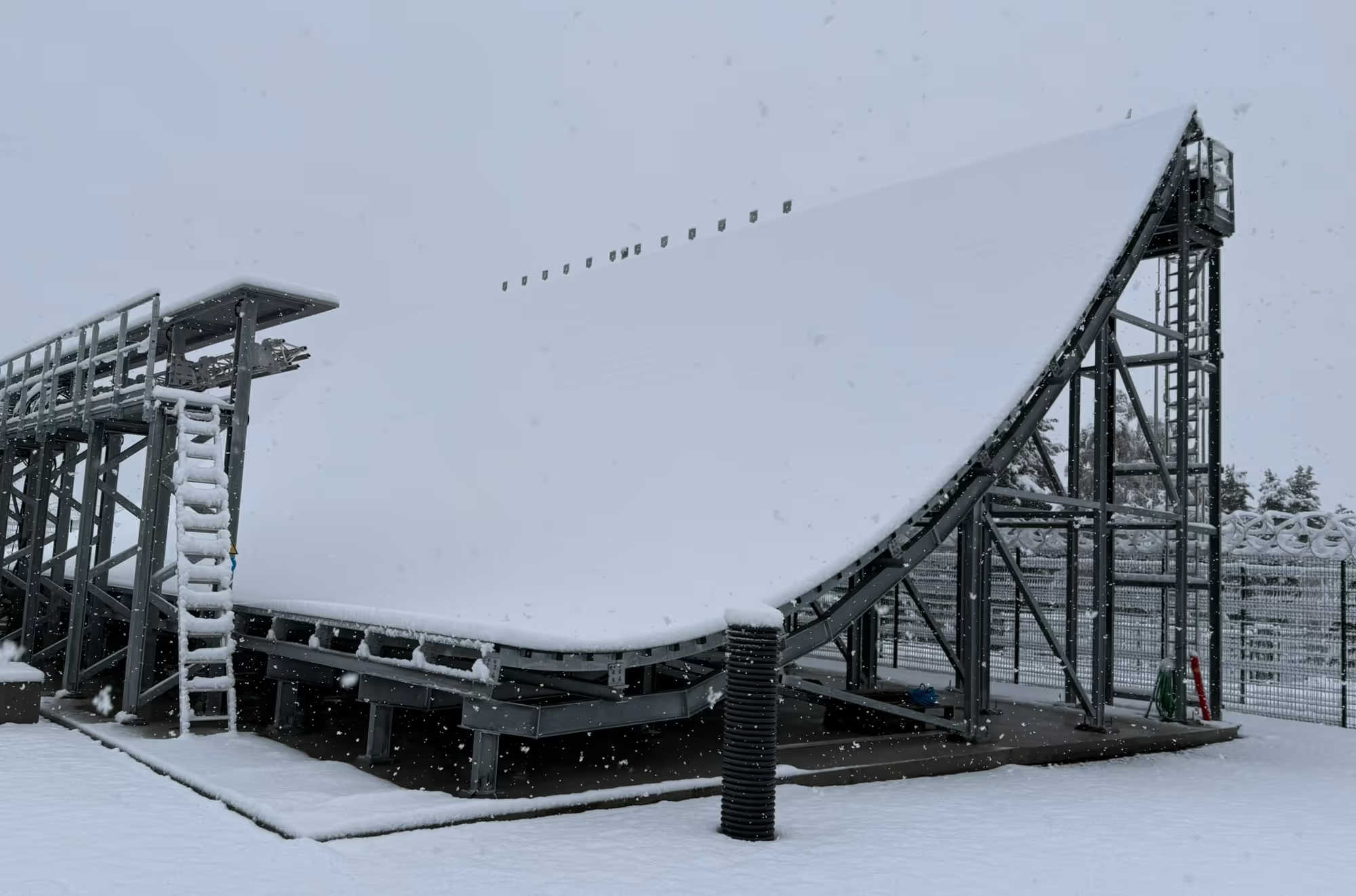
High-performance radars like SORASYS can detect objects of a few centimeters in size in LEO.
Ground-based optical telescopes generally struggle below ~10 cm in LEO and only under very favorable conditions. This limitation is widely documented in SSA literature and operational experience.
Tracking fast objects and abrupt maneuvers
Objects in LEO have very high angular velocities as seen from the ground. Radar systems are well suited to rapid sky scanning, maintaining continuous “tracks” on fast targets, and following objects undergoing sudden maneuvers or re-entries.
On the other hand, when it comes to tracking with optical telescopes, they usually lack the re-pointing (or scanning) speed that an electronically steered radar could provide.
As a result, optical systems could result to be less suitable for achieving proper coverage of fast-paced space events in LEO, such as fragmentation events or atmospheric re-entries, where rapid trajectory changes occur and limited FoV or tasking agility can lead to missed detections.
Resilience to light pollution and orbital congestion
Optical SSA is increasingly affected by:
- Urban light pollution,
- Moonlight,
- Auroral activity,
- Satellite mega-constellation trails (e.g. Starlink).
Radar systems are inherently immune to these effects, making them more robust in a congested and illuminated orbital environment.
Radar vs. Optical: A comparative summary
For continuous, operational SSA, especially in LEO, ground-based radar provides unmatched reliability, availability, and precision. Its ability to operate 24/7, detect small and dim objects, and deliver accurate orbital data makes it a cornerstone technology for modern space surveillance.
That said, the most effective SSA architectures combine radar and optical sensors, leveraging the strengths of both. Data fusion approaches, actively developed within ESA and EU SST frameworks, significantly improve orbit determination and resilience, particularly during dynamic scenarios such as re-entries or fragmentation events.
Conclusion
Ground-based radars are indispensable for robust SSA in Low Earth Orbit. Their continuous availability, independence from light and weather, and ability to detect and track small, fast, and non-cooperative objects make them a critical tool for protecting today’s increasingly crowded orbital environment.
At Look Up, we believe that radar SSA, complemented by intelligent data fusion of other sensor phenomenologies, is key to ensuring the long-term safety, sustainability, and security of space operations.
What to read next
01
October
2026
Look Up invests over €100 million in investment to build strategic space surveillance infrastructure in France’s overseas territories
With its first radar already operational in Lozère, the French company plans to deploy six radars across France’s overseas territories, including two in French Polynesia and one in Saint-Pierre-et-Miquelon, to establish a global space surveillance network.
.png)
11
September
2026
Building a sovereign Space Domain Awareness capability: A strategic necessity for Defence organizations
Why Space Domain Awareness (SDA) has become a critical priority for defence organizations, and how SORASYS ground-based radars and the SYNAPSE digital SDA platform can strengthen national sovereign capabilities in sensing, data processing, and analysis...