




Space War: espionage, intimidation and debris cleanup, what are the strategies at play in orbit?
12
August
2026
“Space war” often brings to mind scenes of laser battles and high-speed chases between spacecraft. In reality, it unfolds in far subtler and less visible ways. Conflict in orbit is already taking shape, as space emerges as a domain of warfare alongside land, sea, air, and cyberspace.
As geopolitical tensions rise, growing reliance on space systems turns satellites into both critical assets and potential targets. In response, major spacefaring nations are expanding their capabilities, investing in dedicated space commands and agencies, surveillance systems, and operational doctrines tailored to this environment. At the same time, weakly enforced rules, complex attribution, and the dual-use nature of space technologies create persistent grey areas, fueling competition and strategic ambiguity.
In this context, various strategies are emerging, from espionage and non-cooperative rendezvous and proximity operations (RPOs) to jamming, spoofing, cyberattacks, and debris-related tactics, all aimed at asserting power without direct confrontation.
Espionage in orbit and the rise of space-based intelligence
Space-based espionage relies on what is commonly known as spy satellites, combining both immediate and long-term intelligence capabilities. Optical satellites capture high-resolution images, allowing analysts to identify equipment, infrastructure and activity on the ground, though they are limited by weather and lighting conditions. Radar satellites fill this gap by providing continuous, all-weather, day-and-night surveillance. In parallel, signals intelligence satellites listen to communications and electronic emissions, providing what General Michel Friedling, Co-founder and CEO of Look Up, calls “hot” intelligence, meaning immediate insight into ongoing operations. These sources are complemented by more “cold” forms of analysis, such as studying the physical features of satellites in orbit to better understand their capabilities and purpose.
This approach to intelligence is also being extended through RPOs, which allow satellites to observe one another at close range. These maneuvers involve spacecraft deliberately moving close together and are essential for servicing missions such as inspection, repair, and refueling. However, they also create strategic ambiguity, as the same capabilities can be used to gather intelligence, interfere with, or even threaten other satellites. Recent activity in low Earth orbit (LEO) shows that some systems, such as Russian ‘nesting dolls’, can release smaller subsatellites with independent movement, blurring the line between inspection and more hostile uses. Even without direct confrontation, repeated close approaches can force satellites to adjust their trajectory, using up fuel and shortening their lifespan, turning routine operations into subtle forms of pressure.
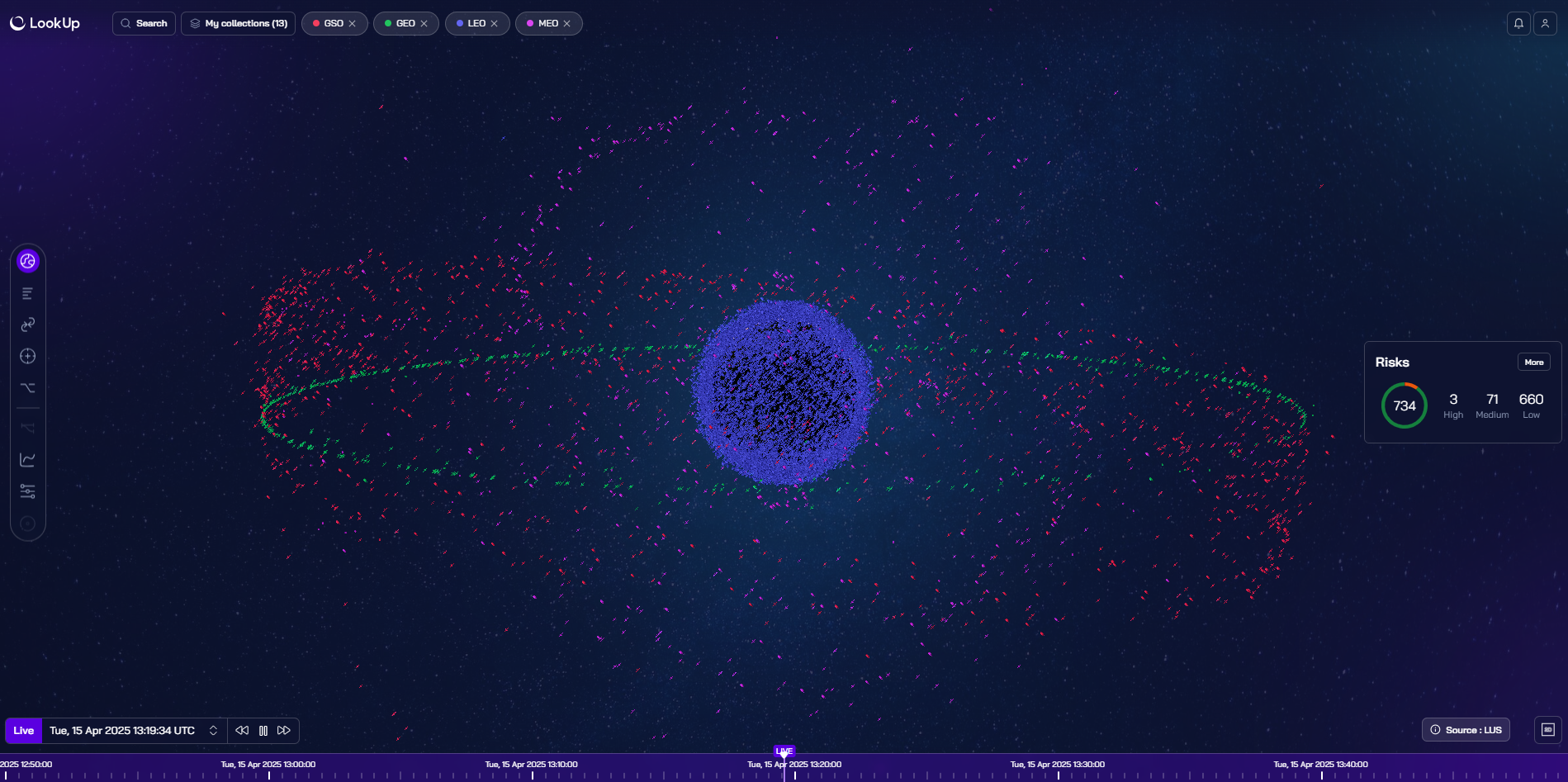
Detecting unusual satellite behavior requires highly precise tracking and advanced analytics to spot routine operations from potentially suspicious activity. Through its SYNAPSE platform, supported by its SORASYS global radar network, Look Up helps identify anomalous maneuvers, strengthening situational awareness and supporting operational readiness in an increasingly contested orbital environment.
Intimidation in orbit and the logic of grey zone tactics
Intimidation in orbit sits at the core of grey zone tactics, where states signal power without crossing into open conflict. This often involves offensive capabilities such as anti-satellite systems (ASAT), including kinetic interceptors, directed energy weapons, and direct ascent missiles, all designed to disable or destroy satellites. While none have been used in warfare, countries including China, India, Russia, and the United States have demonstrated these capabilities by destroying their own satellites, creating thousands of debris fragments. As with many space technologies, the line remains blurred. Launch vehicles developed for civilian purposes can also be adapted for ASAT use, reinforcing the ambiguity that defines operations in orbit.
RPOs are also increasingly used as tools of intimidation in orbit, as their ability to create uncertainty about intent allows actors to apply pressure without crossing clear lines of conflict, forcing others to respond to ambiguous but potentially threatening behavior. Alongside these physical approaches, non-kinetic methods such as jamming, spoofing, and cyberattacks expand the range of options available in grey zone competition. By blocking signals, sending false data, or compromising ground control systems, actors can disrupt or seize control of satellites without leaving visible traces. In this context, intimidation in space no longer relies on destruction but on silent interference, where degraded signals, altered coordinates, and compromised systems can have consequences as significant as physical attacks.
To address these evolving forms of interference, strengthening Space Domain Awareness (SDA) and early warning capabilities becomes critical. In this context, Look Up contributes by enhancing the detection of anomalies and unusual behaviors in orbit, enabling operators to anticipate potential risks before they escalate. By improving visibility and supporting more informed decision‑making, such systems help reduce uncertainty and reinforce the safety and resilience of space operations.
Debris cleanup and the strategic control of the orbital environment
Alongside espionage and intimidation, the management of space debris is emerging as another key strategy shaping dynamics in orbit. The growing number of objects in LEO has turned space debris into a real concern for operational spacecraft. The danger is not limited to immediate damage. Each new fragment increases the chance of further collisions and raises the possibility of a chain reaction known as the Kessler syndrome. In that sense, actions that offer short term advantage can end up weakening the long-term usability of an orbital environment, where even rivals ultimately depend on the same conditions.
To respond to this challenge, different debris removal approaches are being explored. Active methods include robotic arms, nets, and harpoons to capture debris and guide it toward reentry. Other approaches use contactless techniques, such as lasers or beams of charged particles, or attach deorbiting modules to bring inactive satellites down in a controlled way. However, these technologies come with practical and political complexities, especially because they can also be used for other purposes and require operating very close to objects in orbit. This makes accurate tracking and identification essential. Strengthening Space Situational Awareness (SSA) helps monitor debris, anticipate risks, and support safer operations. It also reflects a broader reality: space security and sustainability are now closely linked and depend on continuous attention from all space actors.
In this context, effective debris cleanup depends on accurate tracking and identification. Through its SORASYS sensor network and SYNAPSE data fusion platform, Look Up enables advanced Space Situational Awareness (SSA) and Space Domain Awareness (SDA), supporting real time monitoring, collision avoidance, and safer, more sustainable space operations, helping ensure a secure and resilient orbital environment.
In orbit, the line between competition and cooperation is thinner than ever. As satellites observe one another and operate in an increasingly congested environment, visibility becomes a form of power. In this landscape shaped by strategies of observation, interference, and debris management, actors like Look Up play a key role in maintaining clarity and safety. Ultimately, even competition unfolds within a shared orbital domain, where keeping space usable over time depends on continuously understanding activity in orbit.
What to read next
.png)
11
September
2026
Building a sovereign Space Domain Awareness capability: A strategic necessity for Defence organizations
Why Space Domain Awareness (SDA) has become a critical priority for defence organizations, and how SORASYS ground-based radars and the SYNAPSE digital SDA platform can strengthen national sovereign capabilities in sensing, data processing, and analysis...