



Qianfan, a breakup event, and what it says about the state of LEO
16
July
2026
How a rocket fragmentation event above our heads illustrates exactly why space surveillance is crucial, and what Look Up's SYNAPSE digital SSA platform sees that others miss.
China's mega-constellation ambition
Most discussions about China's Qianfan constellation focus on its scale.
A first operational phase targeting over 1,000 satellites. A long-term vision of up to 15,000 objects in low Earth orbit. A direct strategic response to Starlink, built at speed, with the full backing of the Chinese state.
That ambition is real, and worth taking seriously. But there is another dimension to the Qianfan story that has received less attention, one that matters just as much to anyone operating in, or responsible for, the orbital environment.
It starts with a rocket that should have deorbited, and didn't.
What happened at the first launch
In August 2024, Qianfan's first batch of 18 satellites was successfully deployed. The launcher, a Chinese Long March vehicle, performed the separation as planned. What it failed to do was safely dispose of itself afterward.
Instead of executing a controlled deorbit or passivation burn, the upper stage fragmented in orbit. The result was more than 580 trackable debris objects, released directly into the orbital shell where the Qianfan constellation now operates, around 800 km altitude, near-polar inclination.
Two years on, those fragments are still there. At that altitude, atmospheric drag is minimal. Without active intervention, objects can remain in orbit for decades or even centuries. The debris cloud from that single launch event is not dissipating. It is persisting, drifting, and generating conjunction events on a continuous basis, for Qianfan satellites, and for every spacecraft sharing that region of LEO.
The picture today
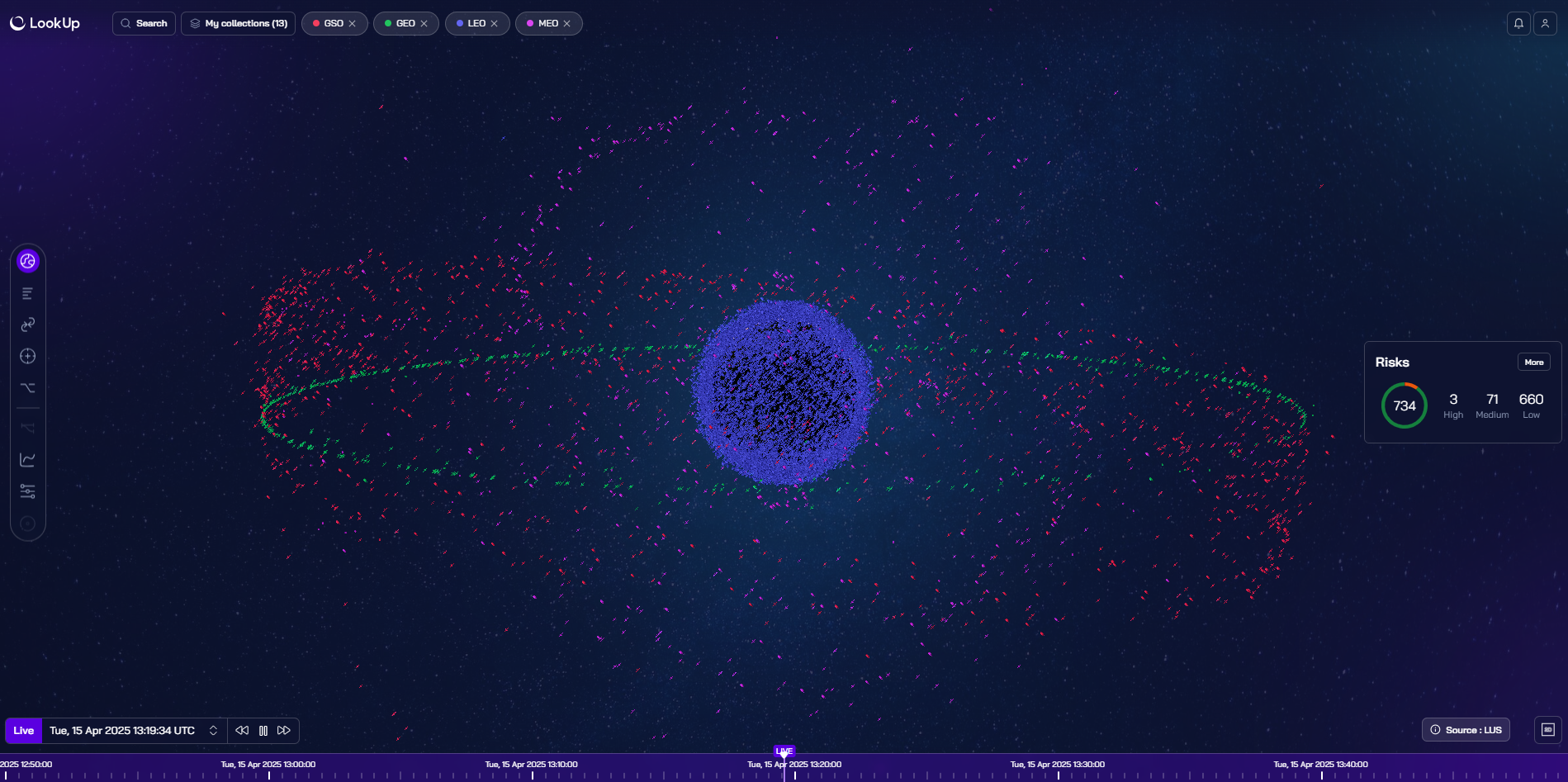
When we look at the full Qianfan object population in SYNAPSE, the numbers are striking.
Of 764 tracked objects associated with the program, 582 are fragments, and 182 are active satellites. The constellation is currently outnumbered three to one by its own debris.
.png)
That ratio tells a story about what a single upper stage disposal can do to an orbital environment. The Qianfan satellites are operational, manoeuvrable, doing what they were designed to do. But they are doing it inside an environment that their own launch history has significantly complicated.
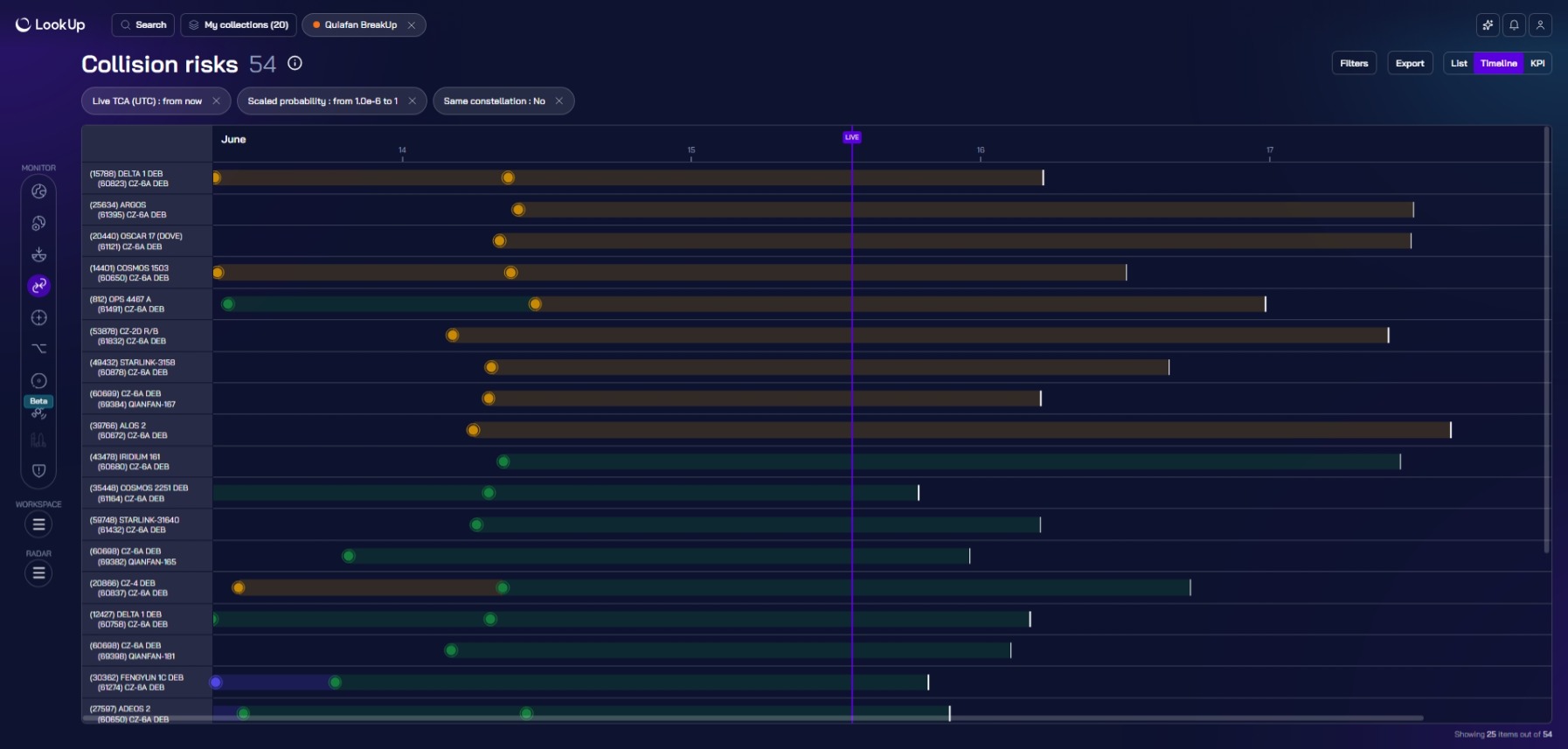
And the problem isn't isolated. The conjunction events generated by the breakup debris involve satellites with no connection to the Qianfan program: IRIDIUM vehicles, STARLINK satellites, ALOS 2, ARGOS, FENGYUN, COSMOS spacecraft. Operators from the United States, Japan, Europe. A fragmentation event above China in 2024 is still generating collision threats for third-party assets in 2026.
In a single day, SYNAPSE has detected 54 active conjunction events linked to this debris cloud. Some of those conjunctions involve manoeuvrable satellites, operators who can, if the risk warrants it, adjust their trajectory and move out of the way. But not all of them. A significant share of conjunction events occurs between two non-manoeuvrable objects: a fragment from the Qianfan breakup and a defunct satellite, an old rocket body, another piece of debris. In those cases, there is no operator to call, no manoeuvre to plan, no intervention possible. If the objects meet, they meet. And if they collide, they generate new debris, which raises the risk for every other object in the vicinity, a dynamic that, once initiated, is very difficult to contain.
This is what makes uncontrolled fragmentation events so consequential. The immediate debris cloud is the first-order problem. The following collisions it can trigger are the second. Surveillance doesn't prevent those scenarios from existing, but it does make them legible, and that matters, both for understanding the true risk exposure of the orbital environment, and for building the political and operational case for better standards before the next breakup happens.
What the satellites themselves look like
Each Qianfan satellite is individually tracked and profiled in SYNAPSE. QIANFAN-1, the first satellite launched in August 2024, is a 267 kg propulsion-capable spacecraft with a 10-metre span. It can manoeuvre. Most of the constellation can.
.png)
But manoeuvrability is only useful if you have accurate, timely information about what you need to avoid. The 582 fragments surrounding the constellation are not all equally well characterised. Some are small and irregular. Their orbital parameters are dispersed. Tracking them reliably, at the cadence that an operational risk assessment requires is not a trivial problem.
The orbital data for QIANFAN-10 gives a sense of the environment. A well-characterized trajectory, near-polar, at around 1,080 km. Stable enough on its own terms. The complexity comes from everything else sharing that space.
.png)
The visibility problem
This is the challenge that sits at the heart of every debris event: you cannot manage what you cannot see.
Most operators today rely on surveillance systems that were not designed for an orbital environment at this density. The data exists in fragments, across multiple catalogues, at varying levels of accuracy and latency. For a breakup event like Qianfan's, the practical consequence is that the conjunction picture any individual operator sees depends heavily on which data sources they have access to, and how well those sources are integrated.
At Look Up, this is the problem SYNAPSE is built to solve. The platform fuses data from multiple sources, including our own SORASYS ground-based radar network, into a unified, real-time operational picture. For a case like Qianfan, that means tracking the full object population from the breakup event, monitoring every conjunction it generates across all affected operators, and providing the analytical depth needed to support actual decisions: when to manoeuvre, how much, with what confidence.
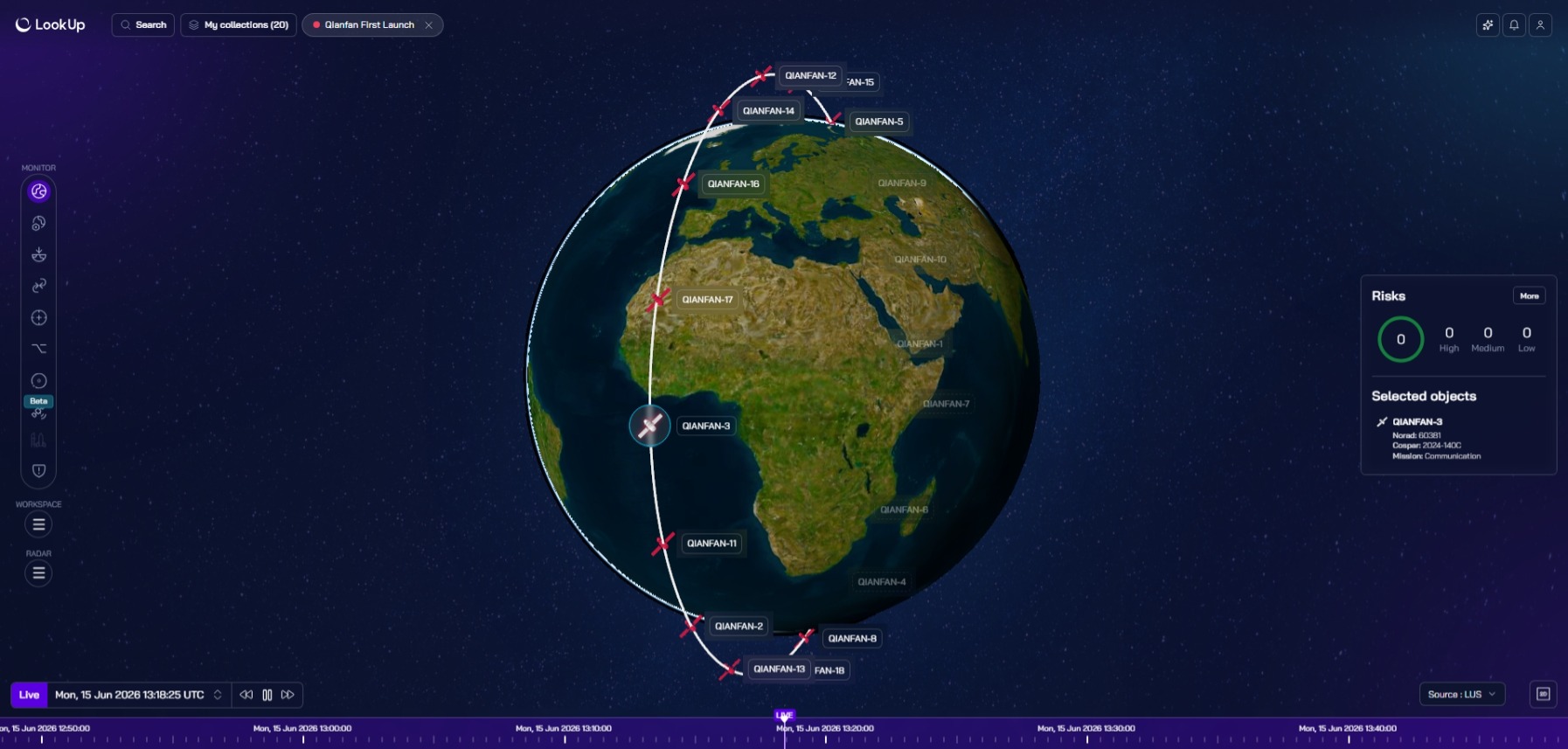
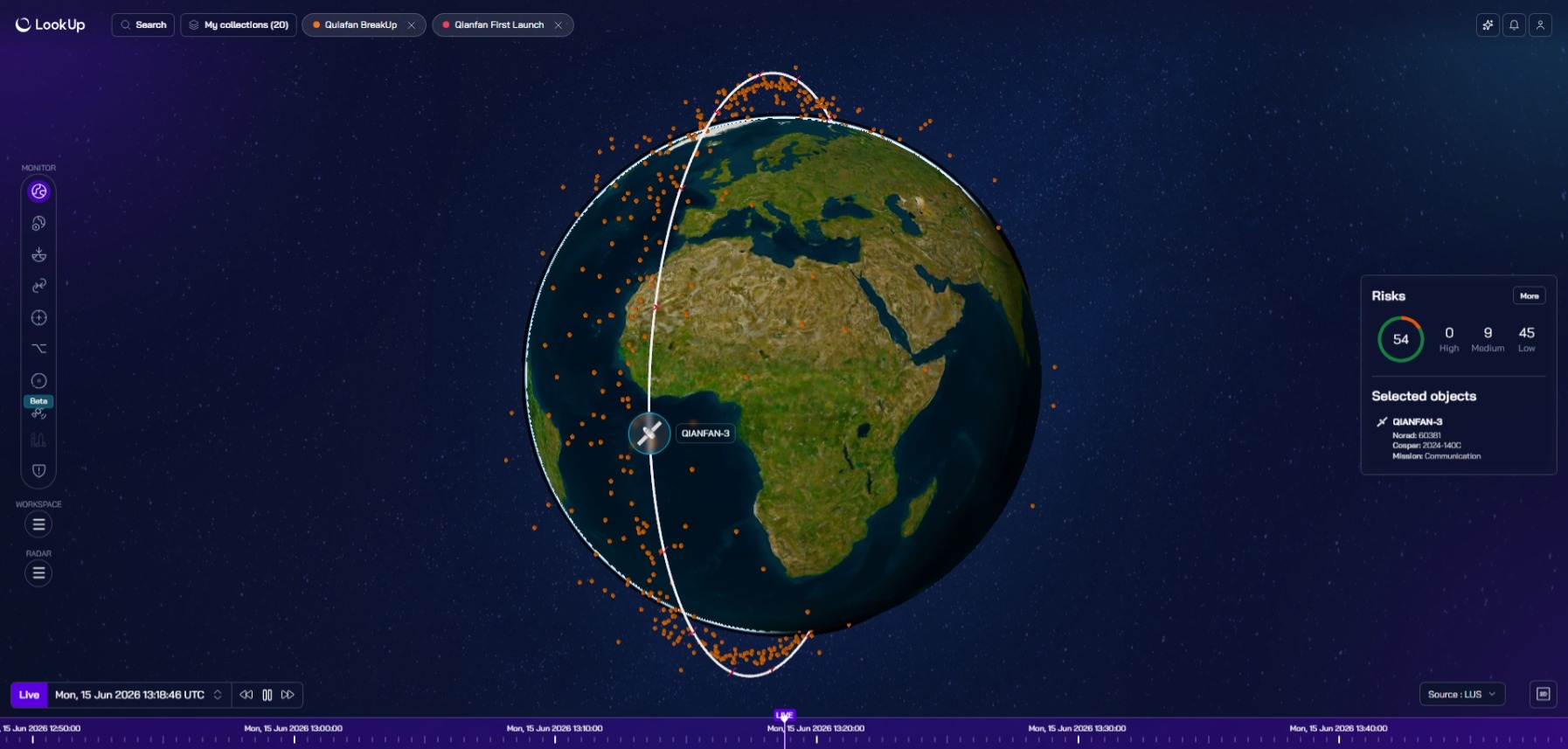
The difference between those two views is the difference between what a launch announcement shows you and what the orbital environment actually looks like. The first is clean. The second is the reality that operators, regulators, and defence agencies need to work with every day.
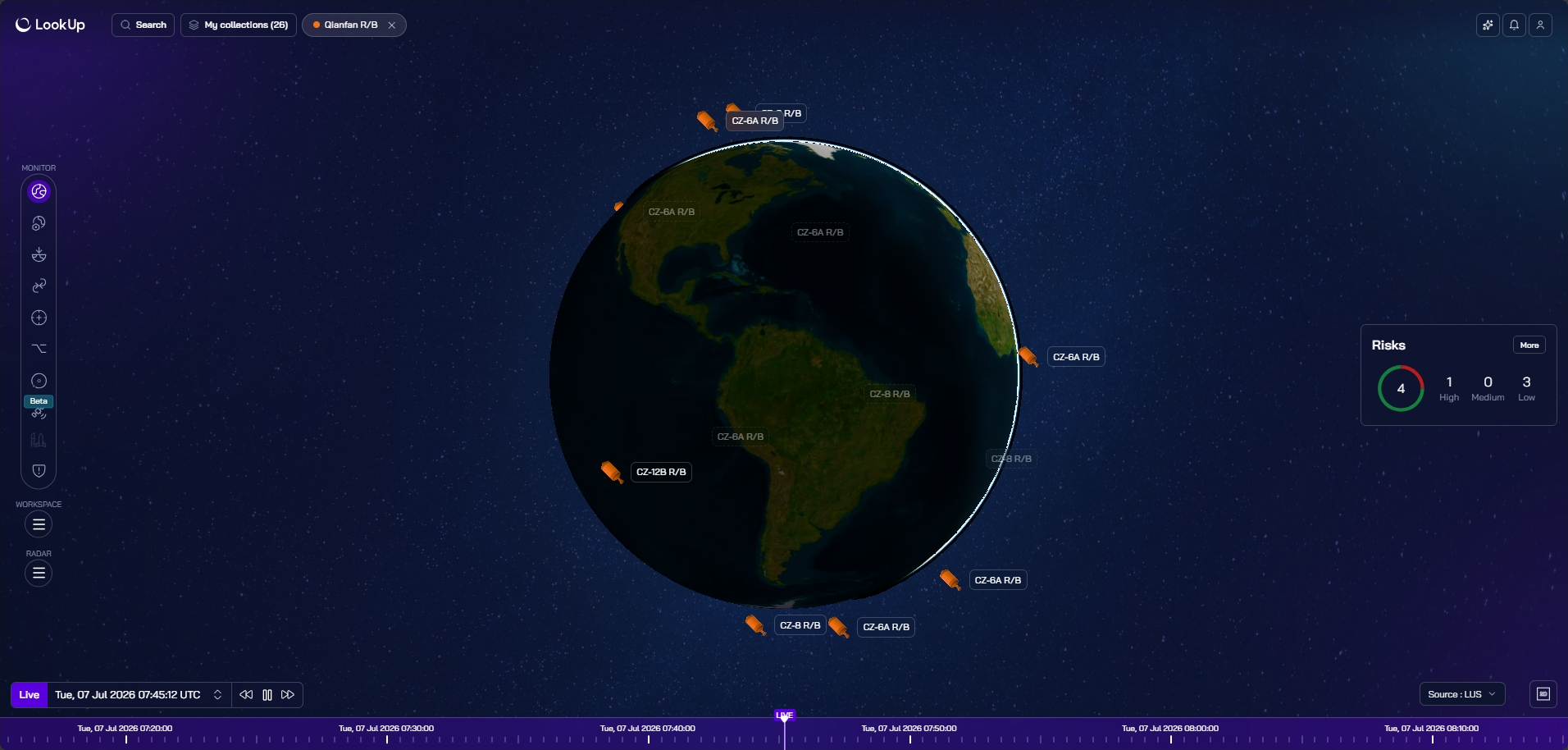
There is also the matter of what is deliberately left behind. Alongside the fragment population, SYNAPSE tracks the rocket bodies associated with each Qianfan launch, the upper stages that separate from the constellation satellites are, in most cases, simply abandoned in orbit rather than deorbited. Twelve launches to date, twelve rocket bodies still up there. Each one is a massive object, orders of magnitude larger than the average fragment, sitting in the same congested region of LEO.
Why this matters beyond Qianfan
Qianfan is not a unique case, but it is a visible one. The pressures that led to an inadequate upper stage disposal in 2024, launch cadence, cost constraints, limited international accountability, are not specific to one program or one country. They are structural features of the current era of space development.
As mega-constellations multiply and orbital altitudes become more congested, the frequency of events like this will increase. The debris population at LEO altitudes compounds. Each fragmentation event raises the baseline risk for everyone operating in that environment, regardless of whether they had any involvement in the launch that caused it.
For defence operators in particular, this dynamic has direct implications. Space-based assets, communications, intelligence, observation, navigation, are critical infrastructures. Their vulnerability to debris is real, persistent, and not dependent on the intentions of any adversary. An independent and continuous surveillance of the orbital environment is what allows operators to maintain situational awareness, anticipate risksand threats, and protect assets that cannot easily be replaced.
The 582 fragments from Qianfan's first launch are being tracked in SYNAPSE, in real time, today. The conjunction events they generate are visible, assessed, and updated continuously.
To see how SYNAPSE covers the Qianfan situation, or to understand the risk picture around your own assets, get in touch with the Look Up team.
What to read next
01
October
2026
Look Up invests over €100 million in investment to build strategic space surveillance infrastructure in France’s overseas territories
With its first radar already operational in Lozère, the French company plans to deploy six radars across France’s overseas territories, including two in French Polynesia and one in Saint-Pierre-et-Miquelon, to establish a global space surveillance network.
.png)
11
September
2026
Building a sovereign Space Domain Awareness capability: A strategic necessity for Defence organizations
Why Space Domain Awareness (SDA) has become a critical priority for defence organizations, and how SORASYS ground-based radars and the SYNAPSE digital SDA platform can strengthen national sovereign capabilities in sensing, data processing, and analysis...