




Starlink, mega-constellations and the absolute need for space surveillance
24
March
2026
For most of the space age, Low Earth Orbit was a relatively quiet place. A few hundred satellites, carefully catalogued, operating in a domain that was complex but legible. The milestone reached on March 17 is a marker of how much that has changed.
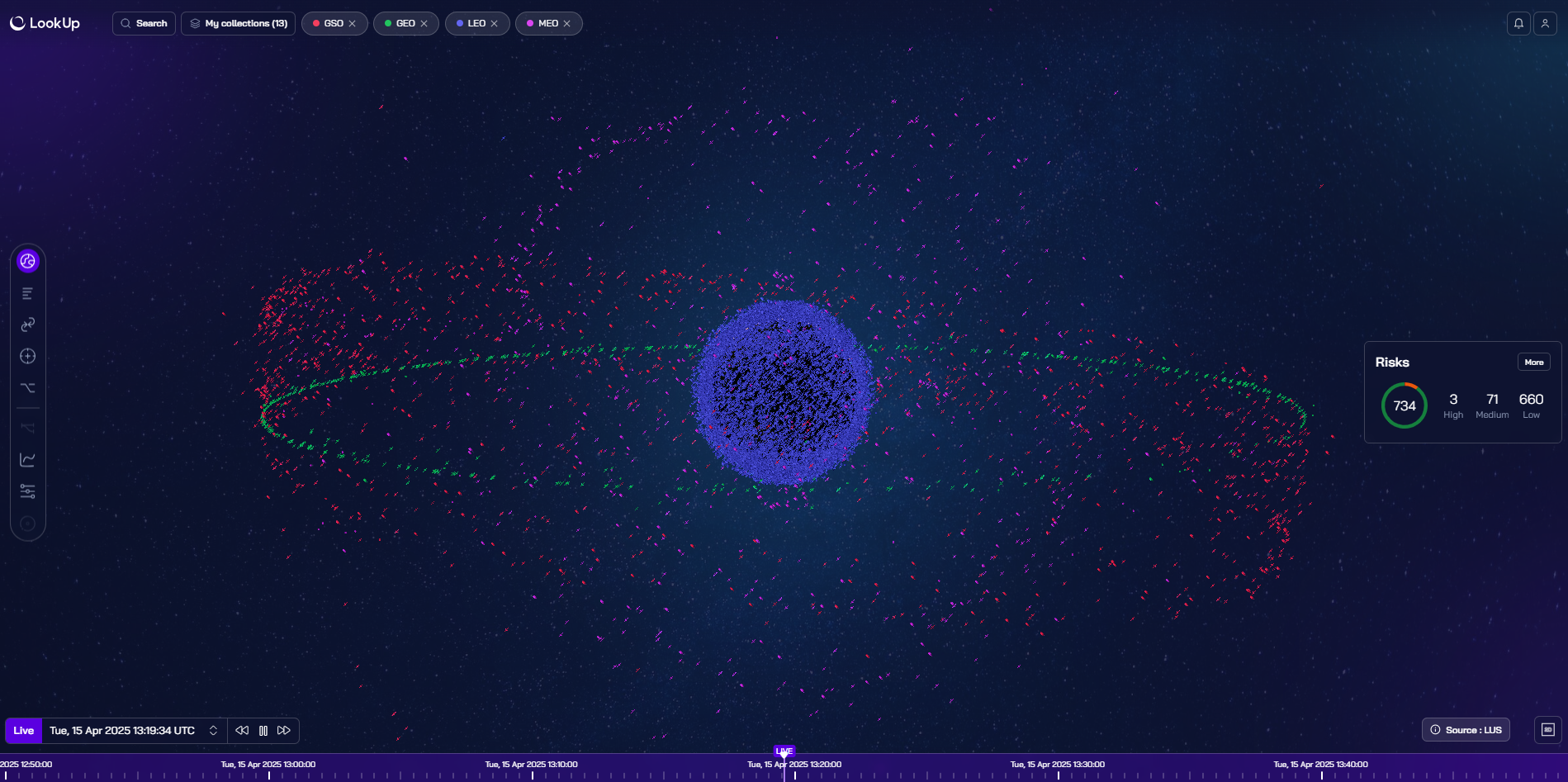
On that date, Starlink crossed 10,000 simultaneously active satellites in LEO. SpaceX reached that number in under seven years. One private company now accounts for roughly two-thirds of every active satellite orbiting Earth, a concentration of satellites in orbit that has no precedent in the history of spaceflight.
From exploration to industrialisation
Starlink has introduced an industrial logic into a domain that was previously governed by scarcity. Launches are frequent. Satellites are replaced routinely, like components in a supply chain. Certain orbital altitudes are now occupied at a density that has no historical equivalent.
And Starlink is not alone: Amazon's Project Kuiper is scaling up, China is building out both Qianfan and Guowang, and a growing number of commercial operators are adding their own constellations to an increasingly crowded environment.
By 2030, low Earth orbit could be home to hundreds of thousands of additional satellites. The orbital environment is becoming critical infrastructure, as essential to modern society as undersea cables or power grids, and subject to the same vulnerabilities that come with scale and density.
The operational reality of a congested orbital environment
Each of these satellites travels at approximately 28,000 km/h. At that speed, even a fragment of debris a few centimetres across carries enough energy to destroy a spacecraft. As the density of objects in LEO increases, so does the frequency of conjunction events, situations where two objects pass close enough to trigger a collision avoidance manoeuvre. These events, once exceptional, are becoming routine.
The core challenge at the heart of space safety is visibility. You cannot avoid what you cannot see, meaning any collision avoidance system is constrained by the data it has access to. Today, most operators rely on legacy surveillance and tracking systems designed for a much less crowded orbital environment. These systems were not built for current conditions, and as a result, the gap between what operators need to know and what they can actually observe, both in quantity and in quality, continues to grow.
Why independent surveillance infrastructure matters
This is not a problem that any single constellation operator can solve alone. Managing the global complexity of the orbital environment requires persistent, independent and high-resolution surveillance infrastructure: systems that can track not just the large, catalogued objects, but the smaller debris that most sensors miss, and that can do so accurately and continuously, at the cadence the current environment demands.
This is the problem Look Up has built its technology around:
- SORASYS, our ground-based radar network, provides high-frequency, accurate sensing data of objects in LEO, including debris too small for most systems to detect.
- SYNAPSE, our space surveillance platform, fuses data from multiple sources, and third-party catalogues, into a real-time operational picture of the orbital environment, giving operators and institutions the intelligence they need to anticipate risks, plan manoeuvres, and make decisions with confidence to guarantee safety of flight.
Extending that visibility into the parts of the orbital environment that remain poorly characterised, and doing so with the independence and rigour that critical infrastructure demands, sits at the core of Look Up's mission.
The governance question
The 10,000 satellite milestone also raises questions that go beyond operations. Who has authoritative visibility over what is happening in orbit? Who can detect anomalous behaviour, assess collision risk, and provide data that operators and regulators can trust? As private actors come to dominate LEO, these are no longer abstract questions. Building credible answers to these fundamental questions is becoming as important as building the constellations themselves.
Space sustainability is a strategic issue as much as an environmental one. An orbit rendered unusable by debris or cascading collisions would have consequences that reach far beyond the space industry, disrupting communications, navigation, weather forecasting, and the critical systems that depend on them. Preserving access to orbit is, in the most fundamental sense, the foundation upon which the entire space economy rests.
Surpassing 10,000 active satellites signals the onset of space’s industrial era. The infrastructure required to govern, observe, track, understand, and protect this environment must evolve in step with the size of the orbital population it oversees.
What to read next
.png)
11
September
2026
Building a sovereign Space Domain Awareness capability: A strategic necessity for Defence organizations
Why Space Domain Awareness (SDA) has become a critical priority for defence organizations, and how SORASYS ground-based radars and the SYNAPSE digital SDA platform can strengthen national sovereign capabilities in sensing, data processing, and analysis...